

Dupuytren's Contracture Surgery
Dr Mun Khin (MK) Chan is an Australian fellowship trained hand surgeon treating Dupuytren's contracture in Sydney, with surgical and non-surgical management options for patients with palm nodules, finger contractures, or concerns about how the condition may progress. Not every case needs treatment — a nodule in the palm without a bend can be watched. Surgery is considered once a finger no longer straightens, and the timing of that decision matters more than in most hand conditions. For patients in Sydney wanting specialist advice or a clearer understanding of Dupuytren's contracture, early review is worthwhile because hand function and day-to-day use can decline as stiffness becomes established; Dr Chan uses evidence-based care and a comprehensive, individualised assessment before recommending treatment, and this page explains the condition, risk factors, symptoms, diagnosis, when to treat, non-surgical and surgical options, procedure details, recovery, risks, and Dr Chan's approach.
MBBS (UNSW) · FRACS · FAOrthoA · Shoulder and Elbow Fellowship (×2) · Hand and Wrist Fellowship · English, Cantonese, Malay
Request an appointment todayWhat Dupuytren's contracture is
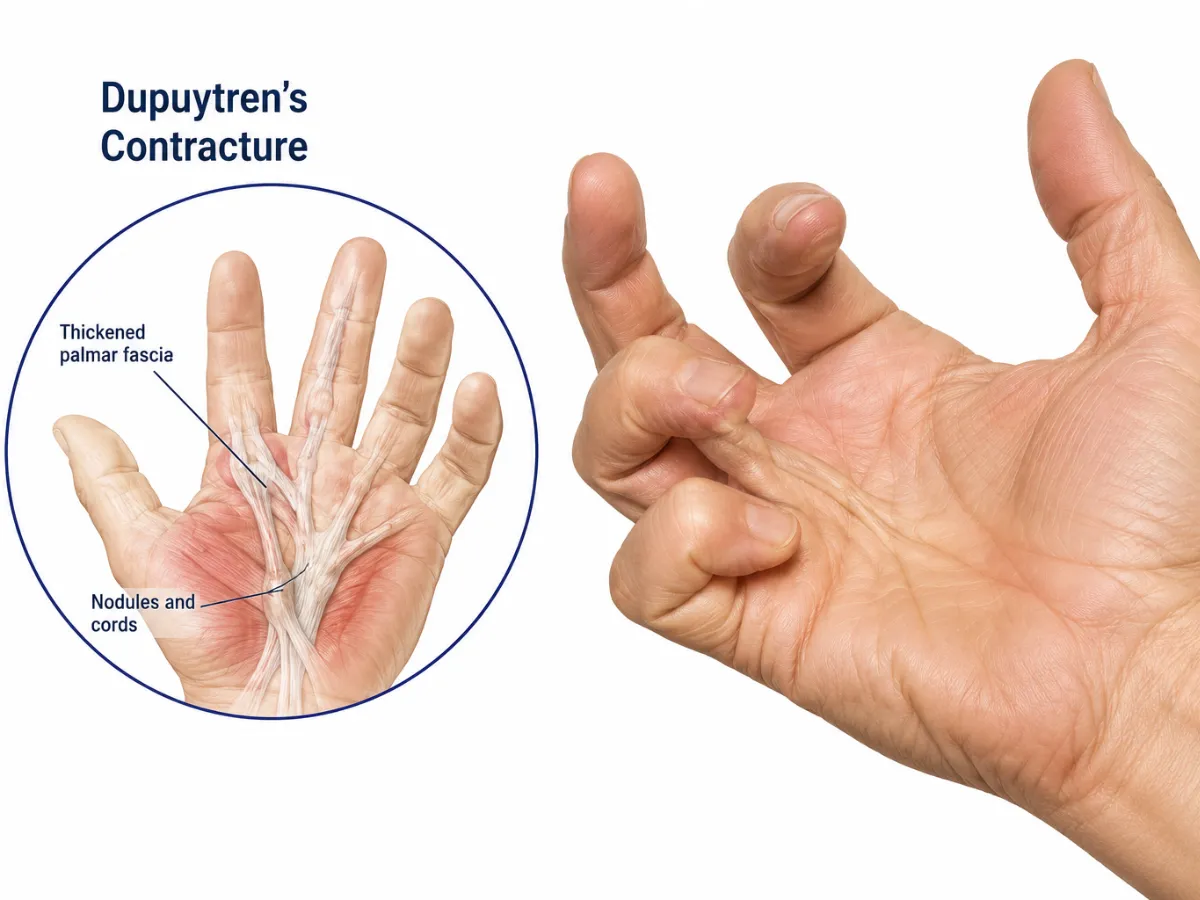
Beneath the skin of the palm lies a layer of connective tissue called the palmar fascia, which anchors the skin so the hand can grip without it sliding.
In Dupuytren's disease, thickening of this tissue occurs abnormally. It begins as a firm nodule in the palm, often mistaken for a callus. Over months to years the nodule can extend into thick cords running towards the finger. As a cord matures it shortens, drawing the finger down into the palm — the contracture, sometimes called Dupuytren's contraction.
The ring and little fingers are the affected fingers in most patients, though the thumb and other digits can be involved. The process is not inflammatory and is not caused by manual work, though it is often noticed after an injury simply because attention is drawn to the hand.
Risk factors
Dupuytren's has a strong genetic component and often runs in families. It is most common in people of Northern European descent — the reason it is sometimes called Viking disease — and affects men more often than women, typically after the age of fifty.
Medical conditions associated with an increased risk include diabetes, epilepsy and arthritis, and smoking and high alcohol intake are further risk factors.
Dupuytren's diathesis describes an aggressive form — early onset, strong family history, both hands affected, and involvement beyond the palm at the knuckles or the soles of the feet. Patients with these factors have a higher risk of recurrence after any treatment, which influences which treatment is chosen and affects long-term outcomes.

Symptoms, affected fingers, and progression
- A firm lump or nodule in the palm, usually painless
- Puckering or dimpling of the skin over the nodule
- A cord developing from the palm towards the finger, felt as a tight band
- A finger that will not fully straighten, most often the ring or little finger
- Being unable to lay the hand flat on a table
- Trouble putting the hand in a pocket, wearing gloves, or washing the face
Nodules are occasionally tender early on, but Dupuytren's is generally not a painful condition. Early signs can include small lumps in the palm, and over time the condition can create difficulty straightening the fingers as the tissues around the joints tighten. It is the loss of extension that limits hand function and, in severe cases, quality of life, and when left untreated this loss of function can also affect mental wellbeing, including anxiety or depression.
Progression varies enormously. Some people have a nodule present for many years that never contracts; others progress within a year or two. If you notice these changes, consult a hand specialist or doctor, or contact the clinic for advice on the next step.
Assessment and diagnosis
The diagnosis is made from your history and a physical examination by a doctor, and imaging is rarely required. Dr Chan will assess the palm for nodules, lumps and thick cords, measure the degree of contracture at each joint because affected joints influence hand movement and treatment planning, and check for involvement of the knuckles or feet. Ultrasound is occasionally used where another diagnosis is being considered.
The tabletop test is the practical measure — if the hand cannot be laid flat on a table, the contracture has reached the point where treatment is usually discussed.
Assessment also covers family history, associated conditions, and the state of the skin, since previous surgery or thin skin over a recurrent cord changes what technique is appropriate. If you notice early symptoms or increasing difficulty straightening the hand, consult Dr Chan or contact the clinic.

Non surgical treatments
There is no medication, splint or set of exercises that will resolve established Dupuytren's disease or soften a mature cord. Splinting does not prevent progression, steroid injections do not reverse a contracture, and hand exercises alone will not straighten a contracted finger. Injections have a limited role, and are occasionally used for a painful nodule rather than to treat the contracture itself.
For a nodule without contracture, observation is the way to manage it — a proportion never progress. Patients suffering pain from a nodule can be treated symptomatically in the meantime. Regular review allows treatment to be timed rather than rushed.
Radiotherapy is used in some centres for early nodular disease in an attempt to slow progression, though its role remains debated.
When treatment is considered
- The hand cannot be laid flat on a table
- A contracture of around 30 degrees or more at the knuckle joint
- Any significant contracture at the middle finger joint, which is harder to correct once established
- Function is limited — grip, washing, gloves, pockets
- Rapid progression
Outcomes vary depending on when treatment happens. Treating too early exposes a patient to surgery they may not have needed. Leaving it too long means the joint, tendons and nerves adapt to the shortened position, and full correction becomes harder. The middle joint of the finger in particular becomes difficult to straighten once it has been bent for a long time.


Treatment options and surgical procedures
Needle fasciotomy, or needle aponeurotomy: The needle is used to break the cord through the skin, under local anaesthetic in the rooms. No incision, immediate correction, and a return to normal activity within days. Recurrence is higher than with surgery, so it suits older patients, a straightforward cord at the knuckle joint, and those wanting minimal downtime — with the understanding it may need repeating.
Fasciectomy: The standard operation. Through a zig-zag incision, the diseased cord and fascia are removed, freeing the finger. Recurrence is lower than with needle release, but it is a larger procedure with a longer recovery. Suits significant contractures, involvement of the middle finger joint, and younger patients.
Dermofasciectomy: Diseased fascia and the overlying skin are removed and replaced with a skin graft. Reserved for recurrent disease and patients with an aggressive pattern, as it has the lowest recurrence rate.
Joint release: Where the finger joint itself has stiffened, additional release of the joint capsule may be needed alongside removal of the cord.
These surgical procedures differ in recovery and recurrence rather than in what they treat. Dr Chan discusses which suits a patient's contracture pattern, age and disease severity at consultation.
The procedure
Fasciectomy is performed under regional block or general anaesthetic, usually as day surgery.
A zig-zag incision is made over the cord, planned so the scar does not itself contract across the finger. The cord is dissected free and removed. The digital nerves and arteries run immediately alongside it and are frequently displaced by the disease, so they are identified and protected throughout — this is the part of the operation that takes the time.
Once the cord is removed the finger is straightened to confirm correction. Where the skin will not close over a fully straightened finger, a graft or an open-wound technique may be used.

Recovery
Days 0–7: A dressing and often a splint. The hand is elevated. Finger movement begins early, guided by a hand therapist.
Weeks 1–3: Sutures removed. Hand therapy continues, usually with a night splint holding the finger straight.
Weeks 3–8: Scar massage, stretching and strengthening. Most patients return to light work in this period.
Months 2–6: Continued improvement in movement and grip. Scar and palm sensitivity settle.
Hand therapy is not optional here. The result depends as much on the therapy program and night splinting as on the surgery, and patients who stop early lose correction. Recovery after needle fasciotomy is far quicker — most return to normal activity within a few days.
Risks and complications
All surgery carries risk, including infection, bleeding and complications of anaesthesia. Risks specific to Dupuytren's surgery include:
- Recurrence: The most important issue. Dupuytren's is a disease of the tissue, not a mechanical problem, and it can return — more likely with an aggressive pattern, younger onset, or after needle release
- Nerve/artery injury: Digital nerve or artery injury, since these are frequently distorted by the cord
- Stiffness: Particularly of the middle finger joint, and reduced hand function where correction is incomplete
- Incomplete correction: Especially where the middle joint was severely bent
- Wound healing problems: Wound healing issues and skin loss, more likely where skin is tight over a fully corrected finger
- Numbness: Numbness along part of the finger
- Complex regional pain syndrome: Uncommon but recognised after hand surgery
Recurrence is not a failure of the operation. It reflects the nature of the disease, and further treatment remains possible.

About Dr MK Chan
Dr Mun Khin (MK) Chan is a trilingual Australian fellowship trained orthopaedic surgeon specialising in upper limb and trauma surgery, with an emphasis on shoulder, elbow, wrist and hand conditions. He converses in English, Cantonese and Malay.
He obtained his medical degree (MBBS) from the University of New South Wales in 2010, completed his orthopaedic training in NSW, and was awarded Fellowship of the Australian Orthopaedic Association (FAOrthoA) and Fellowship of the Royal Australasian College of Surgeons (FRACS). He completed a hand and wrist fellowship, a shoulder and elbow fellowship, and a second shoulder fellowship.
Dr Chan is a 3rd Dan Taekwondo black belt and competed at national and international level prior to his orthopaedic training. He is active in research, teaches doctors and allied health professionals, and received the Dean's Award for Excellence in Teaching from the University of Newcastle.
Frequently Asked Questions (FAQs)
I have a lump in my palm but my fingers are straight. Do I need surgery?
Not at this stage. A nodule without contracture is watched rather than treated, and a proportion never progress. Treatment is considered once the finger no longer straightens, usually when the hand cannot be laid flat on a table.
Will it come back after surgery?
It can. Dupuytren's is a disease of the tissue rather than a mechanical problem, so recurrence is possible with any treatment. It is more likely after needle release, in younger patients, and where the disease pattern is aggressive. Further treatment remains possible if it does.
What is the difference between needle release and surgery?
Needle fasciotomy divides the cord through the skin under local anaesthetic, with recovery in days and no incision — but a higher recurrence rate. Fasciectomy removes the diseased tissue through an incision, with a longer recovery and lower recurrence. The choice depends on the contracture, age and how much downtime is acceptable.
Is it caused by manual work?
No. Dupuytren's is largely genetic and often runs in families. It is sometimes first noticed after an injury simply because attention is drawn to the hand, but manual work does not cause it.
How important are hand exercises and therapy afterwards?
Critical. Night splinting and a therapy program hold the correction while the tissues settle. Patients who stop early lose extension, and the therapy contributes as much to the result as the operation.